
By catching damage the day it happens and tying it to a vehicle, a driver and a shift. Europe’s postal fleets are large, shared between drivers and electrifying fast, so damage that goes unrecorded gets expensive. In ClearQuote’s business cases for European postal operators, automated damage tracking cuts damage costs by around 20 to 25%, which works out at roughly €2m a year for a 5,000-vehicle fleet.
Why Is Fleet Damage So Expensive for European Postal Operators?
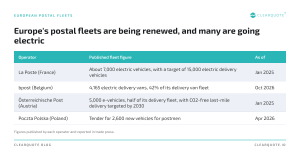
Scale is the first reason. National postal operators run some of the biggest delivery fleets in Europe, and they’re switching those fleets to electric vans in large numbers.
 The way postal fleets work adds to it. Vans go out on daily rounds through narrow streets and tight delivery yards, and the same van often has a different driver from one shift to the next. Most damage is still logged by hand on paper or photo checks, which is slow and inconsistent. A dent found on Friday could have happened on Tuesday, and by then nobody can say whose shift it was.
Why Do Electric Vans Make Damage More Expensive?
Three of the four operators in the table above are adding electric vans every year, and each one costs more to fix than the diesel van it replaces. The AX Repair Index puts the average EV repair at £6,363 against £5,338 for petrol and diesel, 19% more, and 25 days in the bodyshop against 23. AX puts the gap down to dearer parts, and to EVs usually needing sensor calibration even after a small repair.
Those are UK figures and mostly cars, but the pattern carries over to electric delivery vans. A scraped bumper that used to be a quick panel job can now mean recalibrating parking sensors and cameras before the van goes back out.
Time off the road costs more than the repair. Research for Mercedes-Benz Vans put the cost of a van off the road at £1,172.20 a day for UK businesses. For a postal operator, a missing van means a round that has to be covered by another vehicle, reshuffled or run late.
Depot life adds its own risk. Electric vans are parked around charging points and moved in and out of bays through the day. Low-speed knocks in the yard rarely make it onto a damage form, and they’re exactly the kind that cost more on an EV. We covered the same pattern in UK grocery fleets in what vehicle damage costs UK grocery delivery fleets.
Where Does the Money Go?
Three places. The repair bill itself is the obvious one. The second is recovery: when damage can’t be dated, a postal operator can’t recharge a contractor, claim from a third party or show an insurer when it happened. The third is admin, the hours spent reviewing paper forms and photo sets to work out what changed.
All three shrink when every vehicle has a dated record of its condition at each handover.
How Much Could a Postal Fleet Save?
ClearQuote has built business cases for national postal operators across Europe. Estimated damage runs from about €500 to €1,600 per vehicle a year, and the savings come from two sources: damage cost, through about 20 to 25% lower damage plus better recovery and claims, and admin cost.
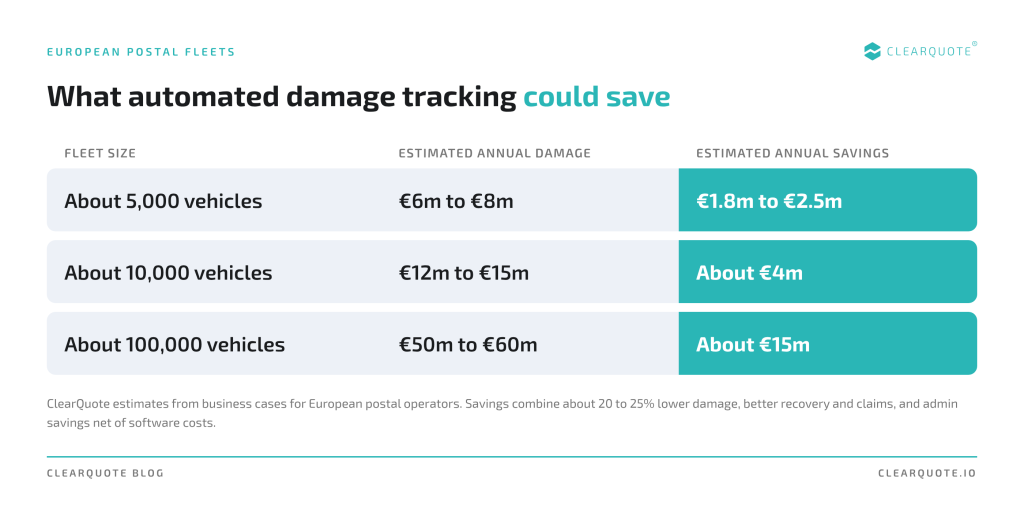
Admin savings are net of ClearQuote software costs. The estimates leave out vehicles off the road and the knock-on effect on delivery rounds.
Worked Example: A 5,000-Vehicle Postal Fleet
Take a national postal operator with 5,000 vehicles and an estimated €6m to €8m of damage a year, or €1,200 to €1,600 per vehicle.
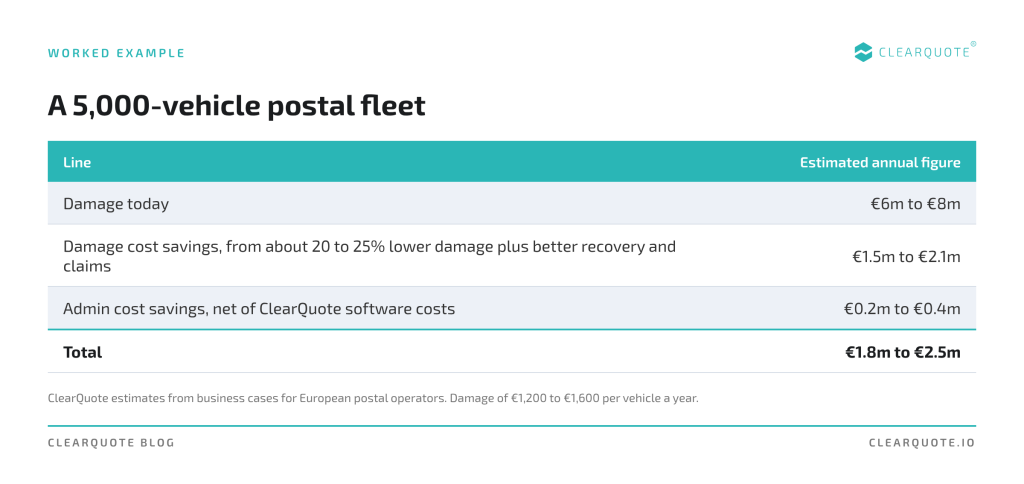
Most of the saving comes from damage that never happens, because drivers know each handover is recorded. The rest comes from damage that does happen but can now be dated, so it can be recharged, claimed or put down to a specific site or shift.
How Does Automated Damage Detection Work in a Postal Fleet?
Images of each vehicle get captured in one of two ways, depending on the site.
At distribution and mail centres, where large numbers of vehicles pass through every day, fixed cameras capture every vehicle’s condition as it drives in and out. Nobody has to stop and walk round it.
At smaller delivery offices, drivers do a daily check with the ClearQuote app. The app guides each photo so no side of the vehicle gets missed, and every inspection is saved with a timestamp, location and driver details.
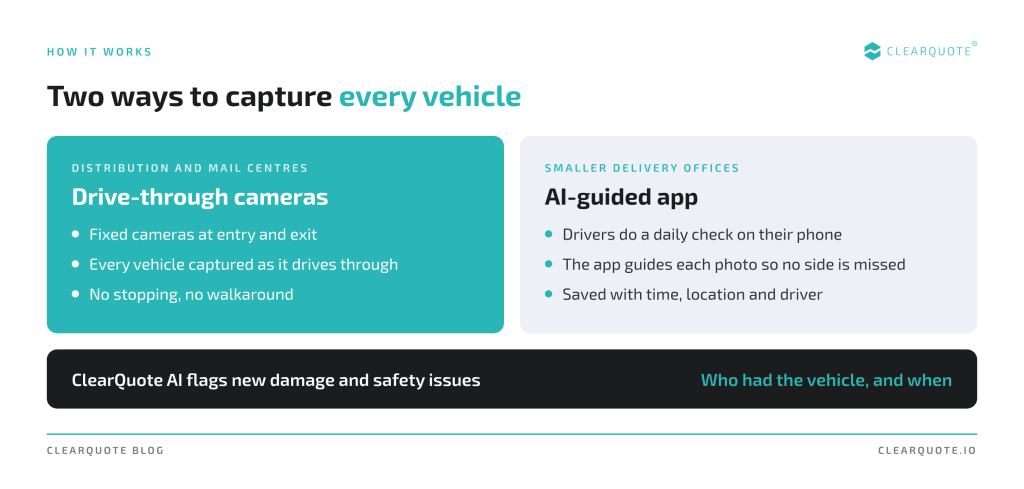
Either way, ClearQuote’s AI compares the images with the vehicle’s last inspection and flags anything new, along with safety issues. The fleet team gets an alert that says what changed, when, and who had the vehicle. The ClearQuote docs cover the setup in more detail.
How Does Drive-Through Scanning Fit a Mail Centre’s Day?
Mail and distribution centres already run on a fixed rhythm. Vehicles leave in waves for their rounds and come back in waves, and each one passes the same gate twice. Fixed cameras at that gate capture the vehicle on the way out and again on the way back, so every round gets a before and after record without anyone stopping.
The scan is quick. Sopp+Sopp, whose drive-through scanner Tesco uses, told Fleet News that “it takes a couple of seconds to do an appraisal – you literally just drive through”. Nothing about the morning wave has to change.
What changes is what happens next. If a van leaves clean and comes back with a new dent, the record shows which round, which driver and which time window it belongs to. The fleet team sees it the same day, while the driver still remembers what happened and before the van goes out on another round.
The same before and after logic works for contractors. Where rounds or linehaul runs are subcontracted, a dated image at handover and return is what makes a damage recharge stick.
What Results Have Similar Fleets Seen?
Damage rates fall once drivers know every handover is on record. ClearQuote has seen damage rates drop 25 to 40% across fleets similar to postal operators, and a 50% average damage reduction across our US Amazon DSP customers*. Those DSPs run shared delivery vans much like postal rounds, and how Amazon DSPs are cutting unreported van damage shows the drop station by station.
Drive-through scanning has public results too. Tesco reported an 18% year-on-year cut in damage-related costs at its Peterborough distribution centre after it started scanning returning vehicles.
*Based on ClearQuote customer data.
Where Should a Postal Operator Start?
At the sites where the most vehicles pass through. A mail or distribution centre with drive-through cameras covers every vehicle that passes through, without changing anyone’s routine. Smaller delivery offices can follow with the app.
Linehaul fleets have a second problem worth planning for at the same time. Postal operators running double-deck trailers sit close to the clearance limit of low rail bridges, which we looked at in why HGVs keep hitting rail bridges.
The first month of data gives a baseline: how much new damage the fleet picks up each week, at which sites, and on which shifts. Postal operators can request a business case for their own fleet at clearquote.io.
Sources
- CEP Research, La Poste to invest €600m to decarbonise French operations
- electrive, Belgian Post fleet now features 4,165 electric delivery vans
- Parcel and Postal Technology International, Half of Austrian Post’s fleet is now electric
- Poczta Polska, tender for cars for postmen
- Bodyshop Magazine, AX Repair Index
- CV Show News, research reveals true cost of vans off the road
- Fleet News, DHL and Culina join Tesco on Fleet Scout damage appraisal pilot