
A vehicle hits a rail bridge in Britain every five hours. In most cases the driver didn’t know, or didn’t check, how tall the vehicle really was. That gap between the height on paper and the height on the road is the problem FiF is built to close. This post sets out the problem. Part 2 covers how FiF tackles it.
How Often Do Vehicles Hit Bridges in the UK?
Network Rail recorded 1,666 bridge strikes in 2024/25, up 8.75% on the year before. The same bridges get hit again and again: Watling Street on the A5 in Hinckley 22 times, and Harlaxton Road in Grantham 18 times.
Railway bridge strikes per year in Great Britain, 2020/21 to 2024/25. Source: Network Rail.
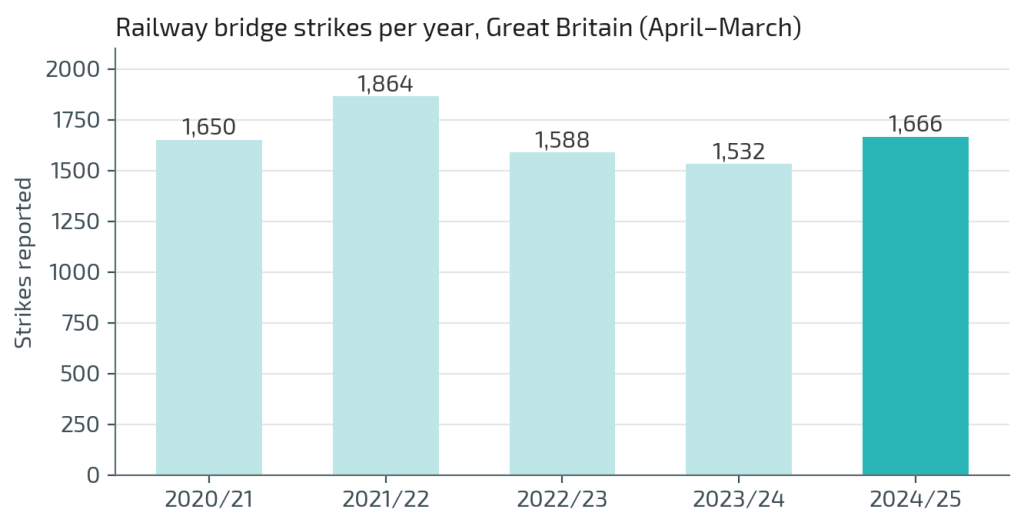
The number has hardly moved in five years, and Network Rail’s Wise Up, Size Up campaign has been running since 2018. Awareness alone isn’t fixing it.
What Does a Bridge Strike Cost?
Strikes cost the UK taxpayer around £23m a year, or about £13,000 each. In 2024/25 they also caused more than 120 days of delays for rail passengers.
The operator pays too. The vehicle and its load take the damage, and the senior traffic commissioner has warned that drivers and operators involved in strikes can lose their licence.
Why Do Drivers Get the Height Wrong?
Mostly because they don’t measure it. Network Rail’s research found 43% of lorry drivers don’t measure their vehicle before setting off, and 52% don’t take low bridges into account when planning a route.
Even a driver who checks once can be wrong an hour later. An HGV’s height changes every time the trailer is swapped, the fifth wheel is adjusted, or the vehicle is loaded or unloaded.
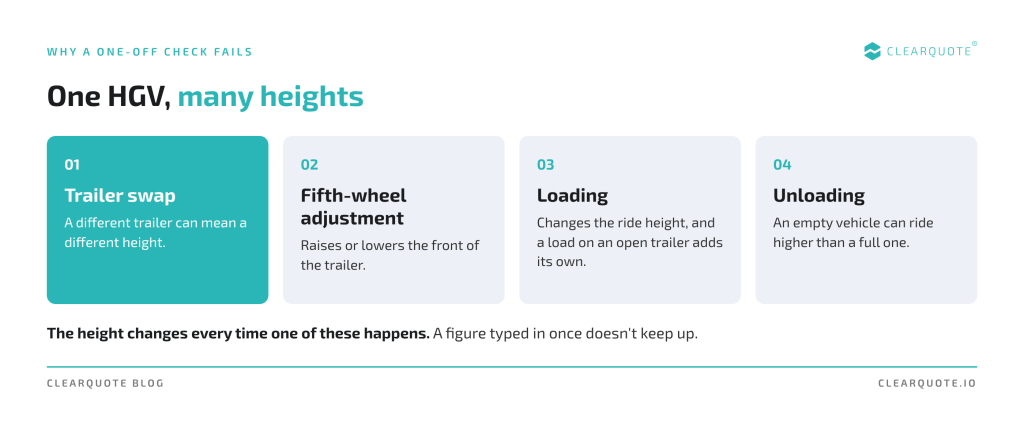 An HGV’s height changes with every trailer swap, fifth-wheel adjustment, load and unload.
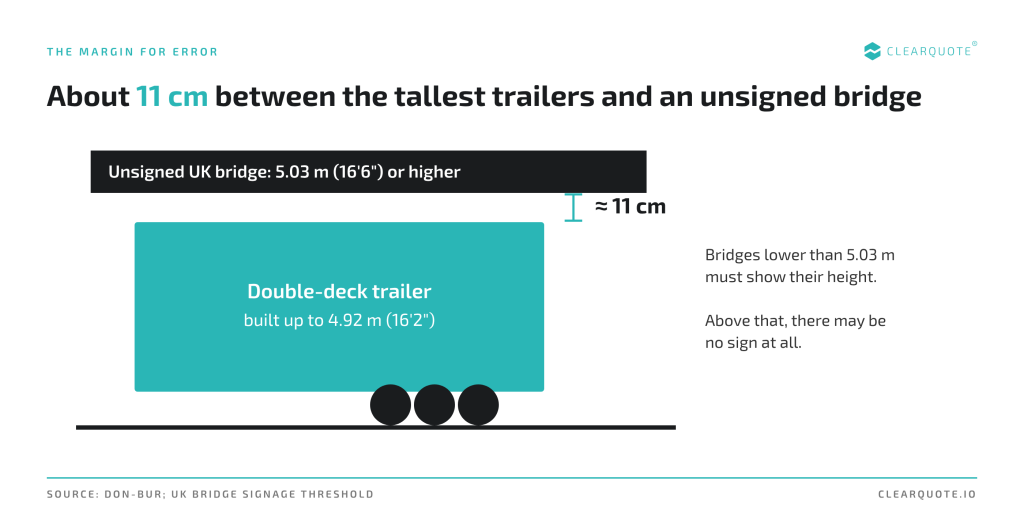
The margin for error is small. Any UK bridge lower than 16’6″ (5.03 m) must show its height, and double-deck trailers are built up to 4.92 m. That leaves about 11 cm between the tallest trailers and a bridge with no sign at all.
About 11 cm separates the tallest double-deck trailers from an unsigned UK bridge.
 What’s Missing From Today’s Tools?
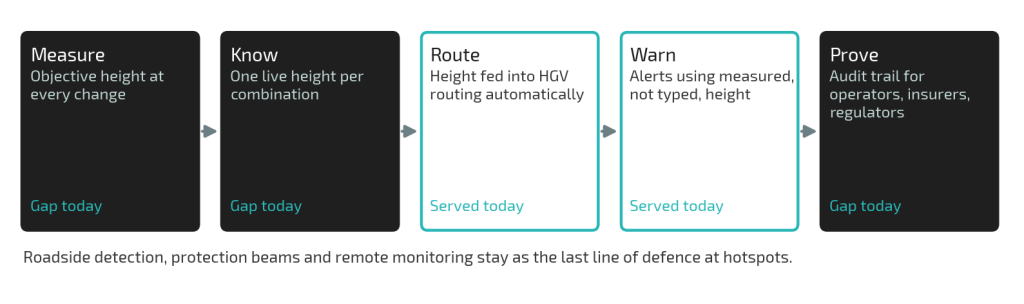
Truck sat-navs and low-bridge warnings already exist, and they help. But they only work with the height someone typed in. Nothing measures the real height each time it changes, keeps one live figure for each truck and trailer combination, or keeps a record an operator can show an insurer or regulator.
Five layers of bridge strike prevention. Routing and warnings are covered today; measuring, knowing and proving height are the gaps.
 FiF is built to close those gaps. Part 2 shows how.