
The UK’s 11 largest grocery retailers run around 47,500 home-delivery vans, HGVs and trailers between them. We estimate vehicle damage costs those fleets about £90m a year, and 78% of that sits with the HGVs and trailers that restock stores, not the vans customers see. Cutting van damage by a fifth and HGV damage by a tenth would save roughly £11m a year. Tesco has already cut damage-related costs by 18% at one of its own depots.

Fleet Damages (Grocery Retailers)
How Big Are UK Grocery Delivery Fleets?
Bigger than most people outside logistics would guess, and nobody publishes the full number. Grocers announce electric van milestones, and the O-licence register lists every HGV and trailer, but almost none of them state a total van count. This is what’s on the public record.
| Retailer | Published figure | As of | Source |
| Tesco | 5,641 trailers on O-licence | Jan 2026 | Motor Transport |
| Tesco | 2,000 electric home-delivery vans, “over 30%” of the van fleet | Sep 2026 | Grocery Gazette |
| Sainsbury’s | 3,800 grocery vans being fitted with AI cameras | Jun 2026 | Retail Systems |
| Asda | 3,770 trailers and 1,933 trucks on O-licence | 2025 to 2026 | Motor Transport |
| Aldi | 1,240 trailers on O-licence | Jan 2026 | Motor Transport |
| John Lewis Partnership (Waitrose) | 1,232 trailers on O-licence | Jan 2026 | Motor Transport |
| Co-op | 1,081 trailers on O-licence | Jan 2026 | Motor Transport |
| Ocado | 2,500+ refrigerated vans and about 200 tractor units | c. 2021 | Transport Engineer |
Tesco’s 2,000 electric vans being “over 30%” of its fleet puts the whole Tesco home-delivery fleet at roughly 6,000 vans. Asda’s trailers and trucks alone come to more than 5,700 vehicles before a single home-delivery van is counted.
We filled the gaps with trade press and our own estimates. Across Tesco, Sainsbury’s, Asda, M&S (through its logistics partner Gist), Ocado, Waitrose, Morrisons, Lidl GB, Co-op, Iceland and Aldi, we count about 19,500 home-delivery vans, 11,400 HGV tractor units and rigids, and 16,600 trailers. That’s around 47,500 vehicles. For Asda and Aldi the public record is higher than our count, so the totals here are more likely to be low than high.
How Much Does Vehicle Damage Cost UK Grocery Fleets?
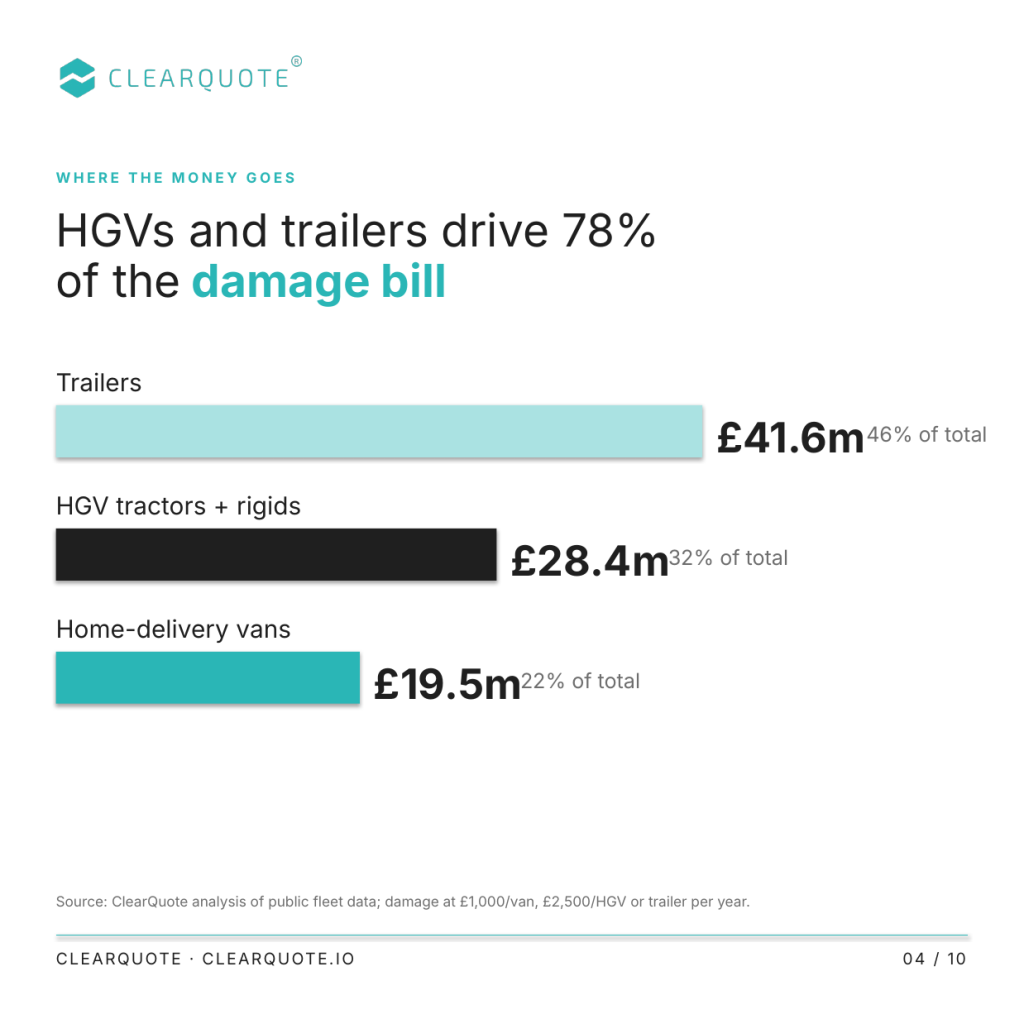
About £90m a year on our numbers. We priced damage at £1,000 per van and £2,500 per HGV or trailer per year, then applied those rates to the fleet counts above.
| Vehicle type | Vehicles | Damage per vehicle per year | Annual damage cost | Share of total |
| Trailers | ~16,600 | £2,500 | £41.6m | 46% |
| HGV tractor units and rigids | ~11,400 | £2,500 | £28.4m | 32% |
| Home-delivery vans | ~19,500 | £1,000 | £19.5m | 22% |
| Total | ~47,500 | £89.5m | 100% |
Trailers £41.6m, HGV tractors and rigids £28.4m and home-delivery vans £19.5m of annual damage across UK grocery fleets
HGV and Trailer Stats
The vans get the attention because they park on residential streets with the logo on the side. The money is in the trailers. A trailer gets coupled and dropped several times a day, pulled by whichever driver is on shift, and reversed onto bays in store yards that were never generous to begin with.
No public source puts an annual damage cost on a UK van or HGV, so there’s no single figure that proves £1,000 is right. The numbers that do exist suggest it’s on the low side.
- The average UK accident repair cost £5,338 for petrol and diesel vehicles and £6,363 for EVs in the AX Repair Index (June 2026). That data is mostly cars. Still, a van with one repair like that every five years is already past £1,000 a year.
- Leasing companies charged an average of £597 per van for damage at the end of a lease in 2025, a record, and 58% of returned vans got a bill (Fleet News, FN50). That only counts damage nobody fixed before the van went back.
- Research for Mercedes-Benz Vans puts the cost of a van off the road at £1,172.20 a day, with UK businesses reporting six and a half days of disruption a year (CV Show News). One day in the bodyshop costs more than our whole annual damage figure per van.
Repair inflation pushes the same way. ABI figures show UK vehicle repair costs rose 31% in a single year, from £4.7bn in 2022 to £6.1bn in 2023 (Marsh). Van insurance premiums have eased in 2026, falling 16.6% year on year according to Defaqto, but the repairs themselves keep getting dearer.
How We Worked Out These Numbers?
Fleet counts combine O-licence data reported by Motor Transport, retailer announcements and trade press, with ClearQuote estimates where nothing was published. Damage rates of £1,000 per van and £2,500 per HGV or trailer per year are ClearQuote planning assumptions, checked against the public repair, lease-return and downtime figures above. Savings assume a 20% reduction in van damage and a 10% reduction in HGV and trailer damage. All figures are as of November 2026.
Why Do Grocery Delivery Fleets Get Damaged So Often?
Why Do Grocery Delivery Fleets Get Damaged So Often?
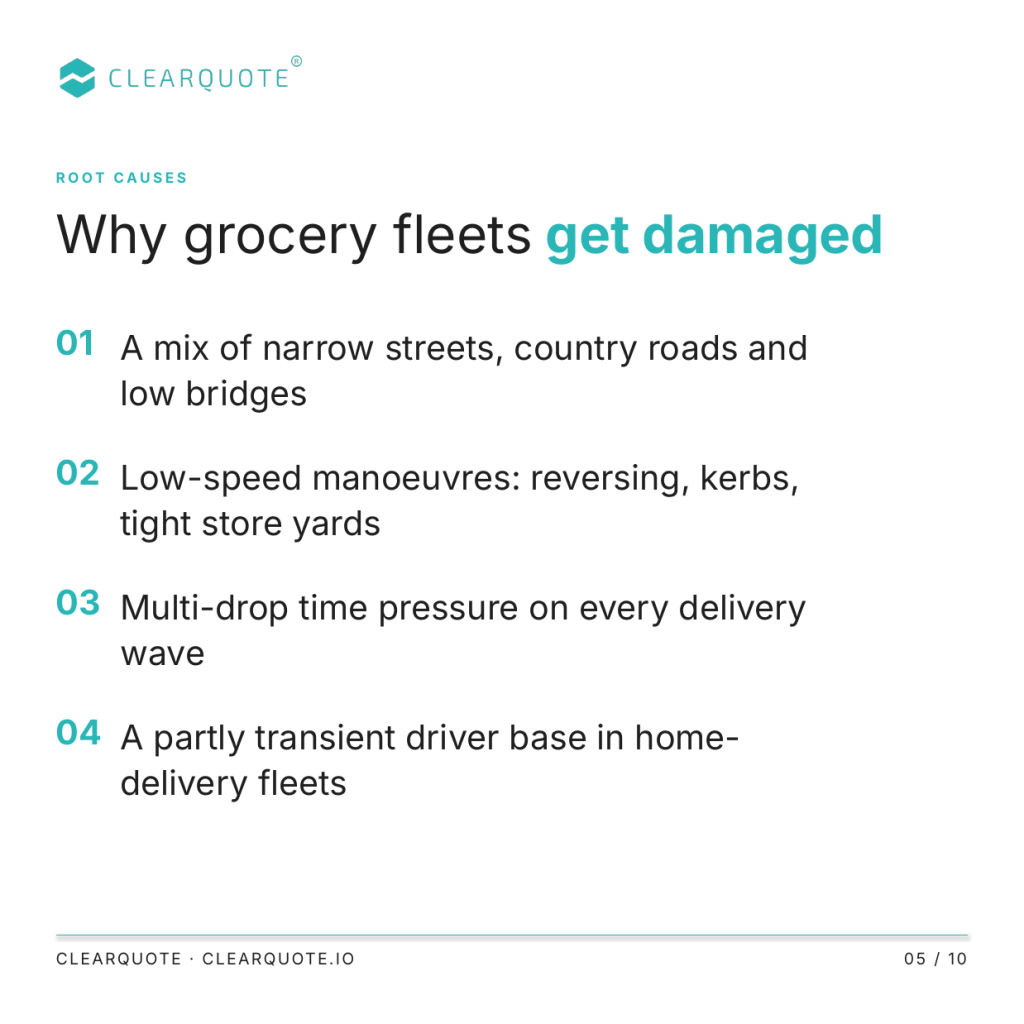
Because the job puts big vehicles in tight spaces, many times a day, against the clock.
Four root causes of grocery fleet damage: narrow streets and low bridges, low-speed manoeuvres, multi-drop time pressure, and a partly transient driver base
A home-delivery van works a mix of terraced streets, cul-de-sacs, country lanes and new-build estates in a single shift. Ocado drivers have described doing anywhere from 10 to 35 drops a day (Ocado blog), and Tesco has said its home delivery fleet makes about 15,000 delivery journeys every day (Van Fleet World). Every one of those stops means pulling in, reversing out, or squeezing past parked cars at a few miles an hour.
That low-speed work drives a big share of fleet damage. Insurer Marsh calls low-speed manoeuvring “one of the most significant drivers of claims costs across commercial fleets”. Think clipped mirrors on parked cars, scraped rear corners on bollards, and dented tail lifts from a loading bay that came up sooner than expected. None of it makes the news, and all of it adds up.
Delivery slots make it worse. Each van runs a fixed wave, and a driver who’s ten minutes behind on drop four is still expected at drop five on time. Rushing a reverse to save 30 seconds is how a rear corner gets crumpled.
The driver base moves too. Home delivery relies partly on agency and seasonal staff, and peak weeks bring big hiring drives: Tesco recruited more than 28,500 temporary workers for Christmas 2025 and Sainsbury’s planned 19,000 seasonal roles (Retail Gazette). Not all of those roles are driving, but a van that has three different drivers in a week is a van whose damage nobody owns.
The HGVs have their own problem: bridges. Network Rail recorded 1,666 bridge strikes in 2024/25, about one every five hours, costing around £12m in delays and cancellations (Network Rail). Supermarket lorries are among them. One Tesco HGV, run by a logistics partner, sat wedged under a Plymouth rail bridge for more than 24 hours (Motor Transport), and the senior traffic commissioner has warned that operators involved in strikes risk their licence.
Why Does Damage Cost Grocers More than Other Fleets?
A dent on a grocery van is rarely just a dent. Four things push the bill up.
Why damage costs grocers more: refrigerated bodies, EV repair costs, chilled and frozen cargo at risk, and liveried vehicles
The bodies are refrigerated. Grocery vans carry insulated, multi-temperature boxes: Ocado runs two-zone PanelTex bodies on Sprinter chassis, Tesco uses low-height climate-controlled bodies with separate fridge units (Transport Engineer), and Iceland’s Sprinters have three compartments for ambient, chilled and frozen (Fleet News). A punctured insulated panel or a door seal that no longer closes properly is a specialist repair, and the vehicle can’t run chilled routes until it’s done.
More of the fleet is electric every month. Tesco doubled its electric home-delivery fleet to 2,000 vans in under a year and plans to be fully electric by the end of 2030 (Grocery Gazette). EV repairs cost 19% more on average than petrol and diesel repairs and take two days longer, because parts cost more and even small repairs usually need sensor calibration (AX Repair Index).
The cargo is perishable. If damage lets warm air into a chilled compartment, the problem stops being a repair and becomes a load of stock that may have to be written off, plus a customer whose order didn’t arrive.
The brand is on every panel. A supermarket van is a moving billboard, parked outside customers’ homes. A 2014 survey of 2,000 UK consumers found 40% said a van’s state of repair shaped their first impression of the business behind it. A scraped, dented van in Tesco or Waitrose livery does the brand no favours.
Why Don’t Cameras And Walkaround Checks Catch It?
Grocers aren’t ignoring fleet safety. Most of what they’ve bought watches the driving, and body damage happens in the gaps.
Sainsbury’s is fitting dual-facing AI cameras to 3,800 grocery vans between June and October 2026, after a trial that cut safety incidents by 77% and harsh braking by 57% (Retail Systems). Tesco has used the Lightfoot driver-scoring app across its home delivery fleet since 2021, alongside in-vehicle cameras and driver trainers (Van Fleet World).
Those tools are good at what they measure. But a 3mph scrape against a bollard barely registers on an accelerometer, and a camera pointed at the road can’t see the rear offside corner.
So body damage still comes down to someone walking round the vehicle with a clipboard or a phone. Ocado, for example, has had marshalling staff walk round each van at check-in to note damage and defects (Transport Engineer). That works on a good day. It’s harder at the end of a long shift, in the rain, in a badly lit yard, with 40 vans coming back in the same hour. And every set of photos still needs someone in the office to review it.
Manual damage tracking falls short: inconsistent checks, hours reviewing photos, and damage that can’t be pinned to a driver
The bigger problem is timing. A dent spotted on Thursday might have happened on Monday, and the van has had four drivers since. Damage that can’t be tied to a shift can’t be charged back or coached out of anyone, so it gets absorbed into the maintenance budget. A Logistics UK feature on unreported fleet damage describes dents going unnoticed “for days or weeks” (Logistics UK).
What Does Automated Damage Inspection Change?
It puts a time and a shift on every new mark, without anyone having to go looking for it.
Images of each vehicle get captured in one of two ways: on a smartphone by the driver or yard staff, or by fixed cameras the vehicle drives past at the depot. Computer vision compares each set of images with the vehicle’s last one and flags anything new, whether that’s a dent, a scrape, a cracked light or a damaged tyre. Safety issues are flagged before the vehicle goes back out, and the fleet team gets an alert about new damage instead of a folder of photos to sort through.
Automated damage assessment: images from smartphones or fixed depot cameras, assessed by computer vision with alerts for new damage
Because every capture is tied to a vehicle, a time and a shift, new damage lands on the shift where it happened. That’s what changes behaviour. Drivers who know the van will be checked the moment it’s back tend to drive it more carefully.
How automated damage tracking helps fleets: no unreported damage, safety issues fixed before the next shift, more driver accountability and fewer incidents
Tesco has already published results. At its Peterborough distribution centre, a drive-through scanning gantry has checked returning HGVs and trailers since January 2025. Cliff Smith, Tesco’s fleet engineering manager, told Fleet News the site saw “an 18% year-on-year reduction in damage-related costs”, and that knowing every vehicle gets scanned changed how drivers behaved. DHL and Culina have since started their own pilots, and Tesco is looking at extending the approach to its vans.
ClearQuote’s numbers come from a different fleet with the same problem. Amazon delivery service partners in the US share vans between several drivers each week, much like grocery home delivery does. Across all our US Amazon DSP customers, damage has fallen by 50% on average, and AI review saves 90% of the admin time that used to go on checking inspection images (Bridge Delivery case study). In the UK, Waitrose is among the grocery fleets using ClearQuote.
How Much Could UK Grocers Save By Tracking Damage Automatically?
About £11m a year across the 11 fleets, on cautious assumptions.
| Vehicle type | Annual damage cost | Assumed reduction | Annual saving |
| HGVs and trailers | £70.0m | 10% | £7.0m |
| Home-delivery vans | £19.5m | 20% | £3.9m |
| Total | £89.5m | £10.9m |
Both reductions sit well below what’s been published. Tesco cut damage-related costs by 18% at Peterborough, close to double the 10% we’ve assumed for HGVs and trailers. ClearQuote’s US Amazon DSP customers average a 50% drop in damage, more than double the 20% we’ve assumed for vans. The £11m also leaves out days off the road, written-off chilled stock and the office hours spent chasing photos, all of which shrink when damage is caught on the shift it happened.
Where Should a Grocery Fleet Start?
With the trailers. They carry 46% of the damage bill and change hands between drivers more than anything else in the fleet. Every one of them also comes back through a distribution centre gate, where fixed cameras can check it without anyone changing how they work.
Home-delivery vans come next. They run out of stores and fulfilment centres rather than a few big depots, so smartphone capture by drivers or yard staff usually fits better than a camera gantry.
The first month of data answers a question most grocery fleets can’t answer today: how much new damage the fleet picks up each week, and on whose shift. Driver coaching and next year’s repair budget both start from that number.
Running a grocery or chilled delivery fleet? See how ClearQuote tracks fleet damage.